
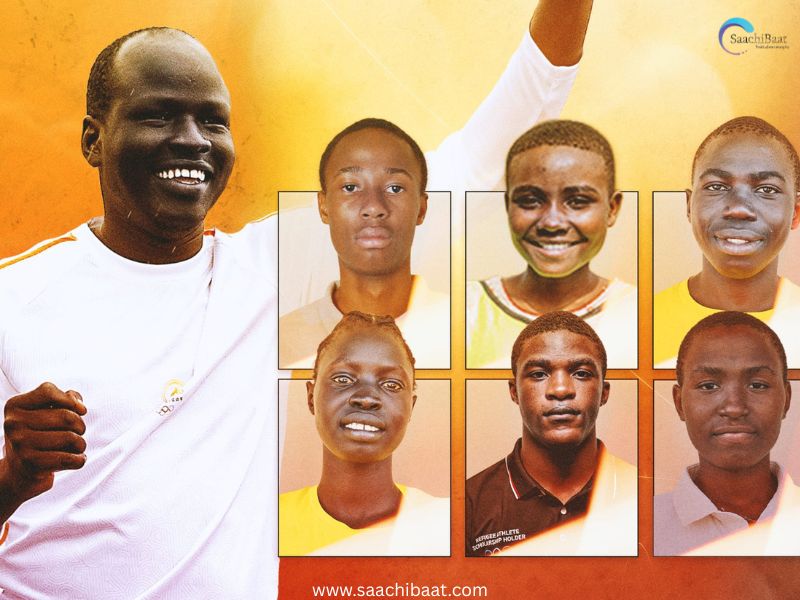
Today, Yiech Pur Biel, Chef de Mission, presented the Refugee Olympic Team (EOR) for Dakar 2026 Youth Olympic Games (YOG) at the 146th IOC Session. The first-ever EOR to compete at a YOG will comprise six athletes and have full gender-parity. In the fourth appearance for the EOR – following the Rio 2016, Tokyo 2020 and Paris 2024 Olympic Games – the athletes will compete in athletics, judo and taekwondo.
In his address to the IOC Session, Biel said of the newly announced team: “These young people have an opportunity to be great ambassadors and represent the millions of young refugees across the world. I look forward to seeing how these young athletes will do in Dakar and I will do my utmost to mentor them to do better during the competition but also in life. I really believe that Dakar will be a life-changing moment for them, but also for refugees watching them worldwide.”
Hosted by the National Olympic Committees (NOCs) of Kenya and Uganda, the team will be composed entirely of African-based athletes and will represent the millions of displaced people across the continent.
The members of the Dakar 2026 Refugee Olympic Team will be:
Arno (Host NOC: Kenya, Sport: Judo, -55kg men)
Clement (Host NOC: Kenya, Sport: Athletics, 800m men)
Florence (Host NOC: Uganda, Sport: Athletics, 200m women)
Lourance (Host NOC: Kenya, Sport: Taekwondo, -49kg women)
Nyataba (Host NOC: Kenya, Sport: Athletics, 800m women)
Rachid (Host NOC: Uganda, Sport: Athletics, 200m men)
The Dakar 2026 YOG represents an opportunity to elevate young refugee athletes, highlight Africa’s role in addressing global displacement and exemplify the IOC’s commitment to supporting refugees through solidarity and inclusion.
In 2026, UNHCR, the UN Refugee Agency, estimates that more than 117 million people are displaced globally, 39% of whom are under the age of 18. East and Southern Africa, where the athletes are based, currently hosts 16 million displaced people, with the largest proportion of refugees and asylum-seekers hosted across Uganda and Kenya.
Originally from South Sudan, Biel spent much of his youth in Kakuma Refugee Camp, Kenya. He was a member of the inaugural Refugee Olympic Team at Rio 2016 and has since gone on to be elected as an IOC Member and become a UNHCR Goodwill Ambassador, and currently sits on the Board of the Olympic Refuge Foundation.
He added: “It has been 10 years since I competed at the Rio Olympic Games as a member of the first-ever Refugee Olympic Team. Since then, sport has truly changed my life. Sport has opened doors for me, and it has also allowed me to change the lives of other refugees – to be a role model for them and hopefully leave a legacy of inspiring others.”
Identifying young talents in Kenya and Uganda
A number of the athletes were selected following trials in both Kenya and Uganda. In Uganda, which hosts almost two million asylum seekers and refugees, athletes were selected from the Olympic Refuge Foundation-funded community programme, Game Connect – marking the first time the ORF’s community work has been directly linked to elite pathways through its Refugee Athlete Support programme, which is funded through Olympic Solidarity.
The Olympic Refuge Foundation and Olympic Solidarity will continue to support the athletes in the run-up to the Opening Ceremony on 31 October. The six selected athletes will participate in a training camp in Kaptagat, Kenya, where they will prepare alongside a number of Kenya-based refugee athletes aiming to compete as part of the LA28 Refugee Olympic Team.
Supporting refugee athletes in Africa and beyond
The Dakar 2026 YOG will take place from 31 October to 13 November, bringing together around 2,700 young athletes aged up to 17 across three host zones: Dakar, Diamniadio and Saly.
Through the Refugee Athlete Support programme, the ORF, with the support of National Olympic Committees and International Sports Federations, gives athletes the opportunity to continue their sports career, in spite of their displacement.
To be eligible for the programme, athletes must be elite competitors in their sport and recognised refugees in their host country, as determined by UNHCR. Founded by the IOC, the ORF adapts sport to meet the realities of humanitarian crises. When forced displacement strips away the routines, community and sense of belonging that hold a young person’s life together, sport can help them regather and rebuild. The ORF works alongside local partners and coaches to create safe places and initiatives where young people can play, connect and find the stability.
××××××××××××××
Telegram Link :
For latest news, first Hand written articles & trending news join Saachibaat telegram group
https://t.me/joinchat/llGA9DGZF9xmMDc1
