
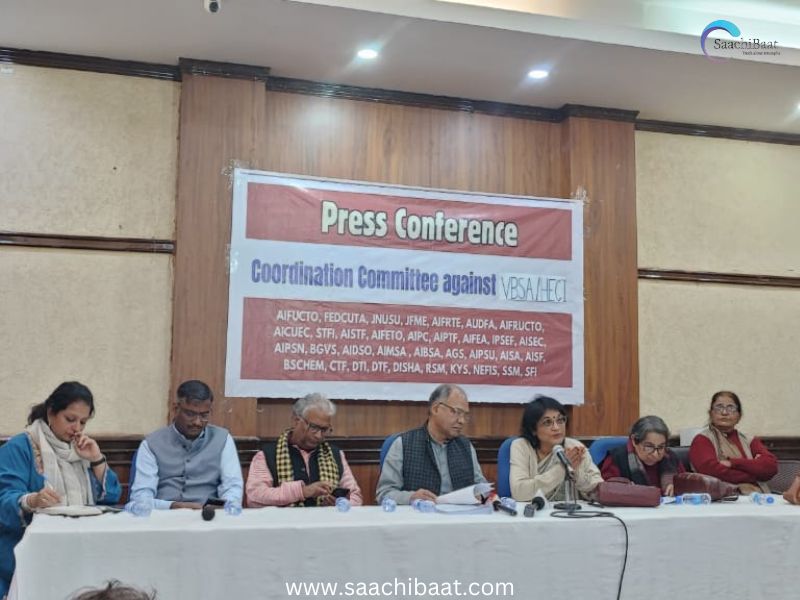
A press conference was held today under the aegis of the **Coordination Committee Against HECI/VBSA and the Joint Forum for Movement on Education (JFME)—a collective representing teachers’ associations from all Central and State Universities across the country—to demand the immediate withdrawal of the Viksit Bharat Shiksha Adhikshan (VBSA) Bill, 2025**, tabled in Parliament.
Addressing the press, Members of Parliament Comrade Rajaram (CPI-ML), Comrade Sivadasan (CPI-M) and Prof. Manoj Jha (RJD) informed that the Bill faced strong and vocal opposition from MPs of all opposition parties. As a result of this unified resistance, the government was compelled to refer the Bill to the Standing Committee on Education for further examination.
The press conference was also addressed by spokespersons of AUDFA, JNUSU, AIFRTE and AISEC, along with representatives of several teachers’ and students’ organisations including CTF, DTF, DTI, SSM, AIDSO and AISA. A joint statement by the President and Secretary of FEDCUTA was also presented. Speakers unanimously asserted that the VBSA Bill constitutes a wholesale attack on publicly funded higher education in India, which is already under severe strain due to the implementation of the National Education Policy (NEP) 2020.
The speakers warned that the Bill would provide legal sanction to the ongoing processes of privatisation, commercialisation, communalisation and exclusion, disproportionately impacting students and teachers from marginalised communities.
Background of the VBSA Bill
On 12 December 2025, the Union Cabinet cleared the HECI Bill under a new name—the Viksit Bharat Shiksha Adhikshan (VBSA) Bill, 2025—and announced its introduction in the Winter Session of Parliament. The draft Bill was uploaded on the Members of Parliament portal on 14 December 2025. However, stakeholders pointed out that feedback submitted on the earlier **HECI Bill, 2018**, has been completely ignored.
The VBSA Bill seeks to repeal three foundational legislations governing higher education in India: the UGC Act, 1956, the AICTE Act, 1987, and the NCTE Act, 1993. Critics emphasised that the current Bill is essentially a revived version of the HECI Bill, 2018, which had received over one lakh adverse responses from teachers, students, educationists, parliamentarians and citizens. Due to massive public opposition, the earlier Bill was shelved by the then NDA government, only to be reintroduced now with cosmetic changes.
Key Concerns with the VBSA Bill, 2025
Speakers at the press conference outlined several grave concerns:
Delinking of Funding and Regulation:
The Bill removes funding functions from regulatory bodies and places grant disbursal entirely under the Ministry of Education. This move is likely to make funding decisions bureaucratic, arbitrary and politically motivated, turning public funding into a tool of reward or punishment and deepening institutional hierarchies.
Centralised and Unrepresentative Composition:
Out of twelve members of the proposed Commission, ten will be either government officials or Central government–nominated experts. Teachers are reduced to just two representatives, undermining academic self-governance. The Commission also excludes representation from SCs, STs, OBCs, women, minorities, persons with disabilities and transpersons.
Highly Centralised Regulatory Regime:
The Bill introduces sweeping powers related to authorisation, graded autonomy and closure of institutions, leading to excessive audits, job insecurity, fee hikes and accelerated privatisation. Its overriding authority over existing laws threatens the federal character of Indian education.
Disregard for Diversity and Equity:
The “one-size-fits-all” approach ignores India’s vast social and regional diversity. The Bill threatens the closure of so-called “underperforming” public institutions, many of which suffer due to decades of policy neglect rather than lack of merit.
Erosion of Institutional Autonomy and Federalism:
Every regulation framed by the Commission requires prior Central government approval, effectively ending institutional autonomy. This undermines education’s status as a Concurrent List subject and risks politicising higher education, curbing academic freedom and dissent.
Deepening the Crisis Triggered by NEP 2020:
Institutions are already grappling with diluted curricula, flawed admissions processes through CUET, rising costs under the four-year undergraduate programme, contractualisation of teaching positions, reduced research funding and shrinking fellowships. Introducing VBSA under these conditions, speakers argued, would be “the final nail in the coffin” of Indian higher education.
Appeal for Wider Consultation
Post-Independence, public investment in higher education has aimed at promoting equity, social mobility and democratic values. The Constitution envisioned education as a **public good**, jointly nurtured by the Centre and the States. The VBSA Bill, speakers warned, represents a structural shift towards extreme centralisation, commercialisation and forced “self-reliance” of public institutions.
As key stakeholders in the education system, the organisations appealed for the Bill to be referred to the Standing Committee on Education for detailed scrutiny, ensuring meaningful consultation with teachers, students and educationists before any such far-reaching reform is enacted.
A detailed Press Note on the HECI/VBSA Bill is attached.
Nandita Narain
Chairperson, Joint Forum for Movement on Education (JFME)
Former President, DUTA and FEDCUTA
××××××××××××××
Telegram Link :
For latest news, first Hand written articles & trending news join Saachibaat telegram group
https://t.me/joinchat/llGA9DGZF9xmMDc1
