
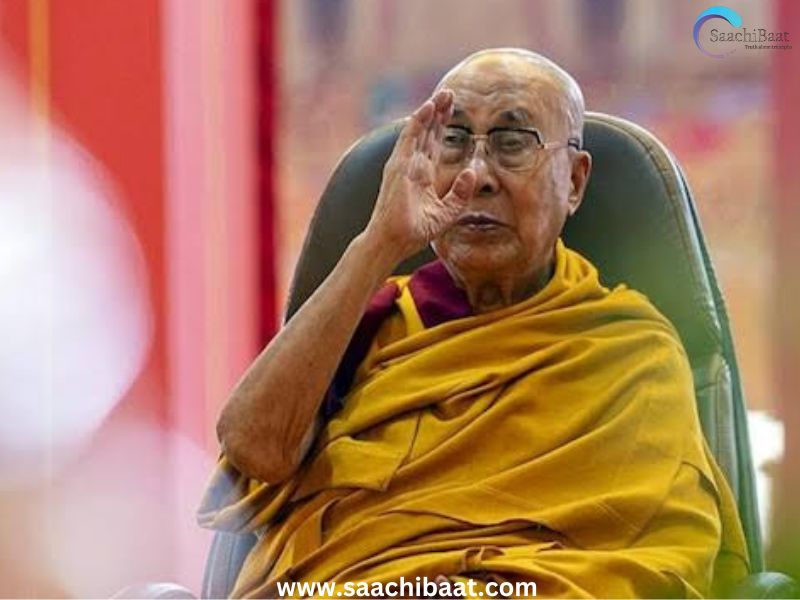
There is a new controversy between the spiritual leader of Tibet, the Dalai Lama, and the Chinese government following the 14th Dalai Lama’s announcement that his reincarnation would be chosen by his institution and not China. Beijing responded assertively by claiming that any subsequent Dalai Lama would need to be approved by the Chinese government, according to its formal policy.
Dalai Lama Declares Independence in Selection of Successor
In recent remarks, the Dalai Lama declared that the Gaden Phodrang Trust, an organization that is in charge of his spiritual and administrative matters, would be responsible for handling the selection of his successor. He explicitly stated that no political authority outside — including the Chinese regime — has any right to intervene in this religious choice.
He also suggested that the new Dalai Lama could be born outside China, perhaps in a nation where spiritual freedom is ensured. This step is being interpreted as a clear attempt to stop China from appointing its own government-ordained successor.
China Firm in Control Over Reincarnation
In response, China’s Foreign Ministry reaffirmed that religious life in Tibet should comply with Chinese law. According to a government spokesperson, any reincarnation of the Dalai Lama would have to be formally approved by Beijing, asserting that Tibetan Buddhism is under Chinese jurisdiction.
The official further stated that any process outside government regulations would be invalid, underlining the fact that reincarnation has traditionally involved state control — something China still maintains through laws.
Political and Religious Implications
Succession has been a cause of controversy for a long time. When the Dalai Lama recognized a young boy to be the 11th Panchen Lama in the 1990s, Chinese officials arrested the child and recognized another candidate. That still remains unresolved, raising fears of China using a similar tactic with the Dalai Lama’s replacement.
Tibetan exiles say that religious traditions have to be maintained free from political influence. Experts opine that in the case of two different Dalai Lama claimants, one from Tibetan in exile and the other from China, it may split international recognition and heighten tensions.
As the 14th Dalai Lama is on the threshold of his 90th birthday, succession has emerged as a symbolic battle between spiritual autonomy and government control. Since both sides remain adamant, the destiny of Tibetan Buddhism is on the verge of a serious challenge.
××××××××××××××
Telegram Link :
For latest news, first Hand written articles & trending news join Saachibaat telegram group
https://t.me/joinchat/llGA9DGZF9xmMDc1
